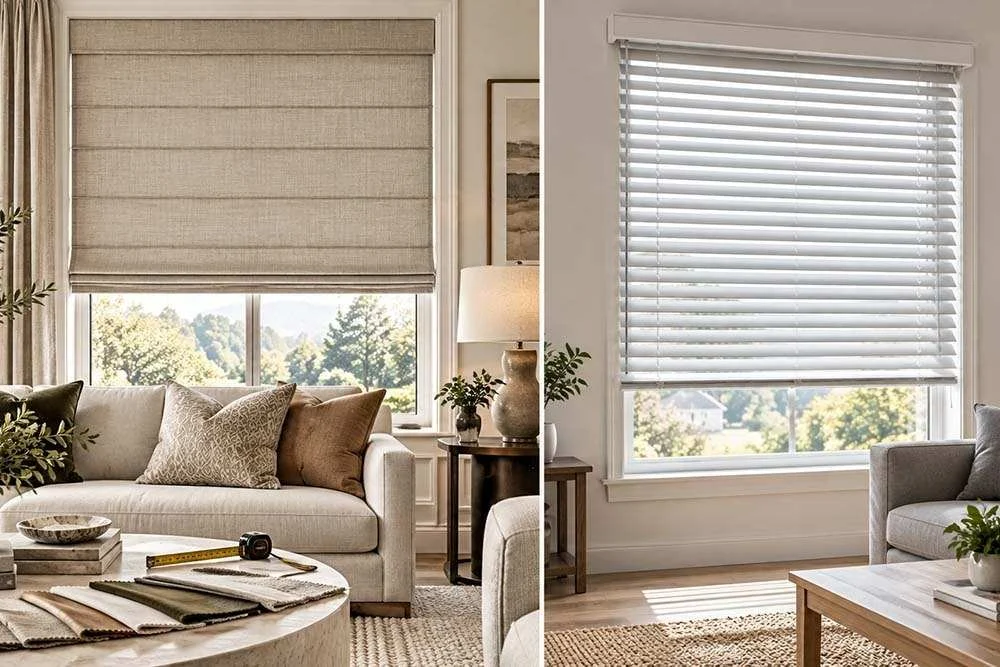
The most important difference between custom blinds and ready-made blinds is not branding or price. It is who adapts to whom. With a ready-made blind, the window has to work with a size and specification that already exists. With a custom blind, the product is planned around the actual opening and the way the room is used.
That difference can affect edge gaps, light control, alignment, privacy, fabric choice, operating method and the overall finish. It does not mean every window needs a custom solution. It means the value of custom becomes clearer as the window, the room or your expectations become less standard.
What Counts as a Ready-Made Blind?
Ready-made blinds are produced in predetermined sizes and commonly requested colours or fabrics. You choose the closest match, purchase it and install it yourself or arrange installation separately. The model is efficient because one product can suit many homes.
That efficiency is also the limitation. If the nearest available width leaves more gap than you want, if the length is awkward or if the room needs a specific opacity, you are choosing among compromises rather than specifying the outcome.
What Makes a Blind Custom?
A custom blind starts with the opening. Measurements, mounting conditions, product type, fabric, finish and operating system are selected for that specific window. The goal is not merely to make a blind “special”; it is to remove unnecessary compromises where they matter.
For Calgary homeowners considering made-to-measure options, the Window Blind Manufacturing page is a useful internal reference for the custom process.
The Real Comparison: Fit, Function and Finish
| Factor | Ready-Made Blinds | Custom Blinds |
| Sizing | Limited to standard dimensions or adjustable retail ranges. | Planned around the measured opening and chosen mount. |
| Fabric choice | Usually a narrower set of mass-market options. | Typically broader choice of opacity, texture and finish. |
| Edge gaps | May be acceptable but depend on how closely the standard size matches. | Can be planned more precisely for the opening and performance goal. |
| Installation | Often DIY or arranged separately. | Can be integrated with professional measuring and installation. |
| Speed | Often faster when the right size is already in stock. | Usually involves measuring, ordering and fabrication time. |
| Best use case | Simple, standard windows with basic requirements. | Visible, unusual or performance-sensitive windows where fit matters more. |
When Ready-Made Blinds Are a Sensible Choice
A ready-made blind can be completely reasonable when the window is close to a standard size and the room has simple requirements. A utility room, rental space, temporary office or low-priority basement window may not need a detailed design process.
If the available product fits acceptably, provides the necessary privacy and looks appropriate for the room, there is no rule that says custom is automatically better. Paying for precision where you do not value precision is not good buying either.
Where Custom Blinds Usually Earn Their Value
Custom becomes more persuasive when the window is large, highly visible, unusually shaped, part of a group or expected to perform a specific job. Bedrooms are a good example: even a modest side gap can become noticeable when you are trying to reduce early-morning light. In a front living room, uneven alignment across several windows may be visually obvious.
The more important the fit is to the room, the less useful “close enough” becomes.
Light Control Is Partly a Sizing Problem
Buyers often focus entirely on fabric when discussing room darkening. Fabric matters, but the opening around the fabric matters too. An opaque blind can still admit light around its edges if the sizing or mounting leaves substantial gaps.
Custom measurement cannot eliminate every possible source of light – architecture and mount type still matter – but it allows the blind to be specified with those conditions in mind. That makes the conversation about performance more precise than simply choosing a darker swatch.
Privacy Also Depends on the Finished Edges
The same principle applies to privacy. A material may be completely opaque while still leaving a direct sightline beside the blind. On a second-floor spare room that may be irrelevant. On a street-level bedroom it may be the most important detail in the entire purchase.
Evaluate the window from the location where another person would actually see it. Fit is not an abstract specification; it changes the real-world result.
Custom Does Not Automatically Mean Higher Quality
“Custom” describes how the blind is specified, not a guarantee of materials or workmanship. A responsible comparison still looks at hardware, mechanisms, fabric quality, warranty support and installation standards. Likewise, some ready-made products are well engineered and perfectly adequate for their intended use.
The best buying question is therefore not “Is it custom?” but “What exactly is being customized, and what problem does that customization solve for me?”
Compare Total Cost, Not Sticker Price
Ready-made blinds usually win on immediate purchase price. Custom blinds add measuring, fabrication choices and often installation. However, the total-cost comparison should also include the likelihood of buying twice, replacing a blind that never fit well, or accepting a result that does not meet the room requirement.
For a temporary or simple situation, a lower-cost standard product may be the better value. For a major living area or a difficult opening, paying more once for the right fit can be easier to justify.
A Practical Rule for Choosing
- Choose ready-made when the window is standard, the need is basic and the closest retail size fits well enough.
- Choose custom when precise fit, coordinated appearance, unusual dimensions or specific light/privacy performance matters.
- Use a mixed approach if that suits the house: custom in high-priority rooms and standard products in secondary spaces.
- Before ordering anything, decide whether the window is a “good enough” window or a “needs to be right” window.
Original Visual Proof to Add
| Use real Winmax project imagery rather than generic stock photos.
· Close-up comparison of a standard-size blind with visible side gaps versus a custom-fitted Winmax installation. · A multi-window project showing consistent alignment across adjacent blinds. · Measurement and installation photographs that demonstrate the process, not just the finished room. |
Frequently Asked Questions
Q1. Are custom blinds always better than ready-made blinds?
A: No. Custom blinds are most valuable when precision, appearance or specific performance requirements justify the extra process. A ready-made blind can be perfectly suitable for a simple standard window.
Q2. Why do custom blinds usually cost more?
A: They involve measurement, product specification and made-to-order fabrication, and may include professional installation. The additional cost reflects that tailored process.
Q3. Can ready-made blinds be trimmed to fit?
A: Some products allow limited adjustment, but this varies by product. Trimming does not automatically create the same result as a blind specified for the opening.
Q4. Are custom blinds worth it for bedrooms?
A: They can be, particularly when privacy, edge gaps and light reduction are important. Bedrooms are one of the places where a precise fit can be noticed most.
Q5. Should every window in my home be custom?
A: Not necessarily. Many homeowners can use different levels of investment by room, focusing custom solutions on the windows where fit and performance matter most.
Q6. What should I compare in a quote besides price?
A: Look at measurement, product type, fabric, hardware, operating system, installation, warranty and what happens if an opening presents an unusual fitting condition.
| Use custom where precision adds value – and keep simple windows simple. |