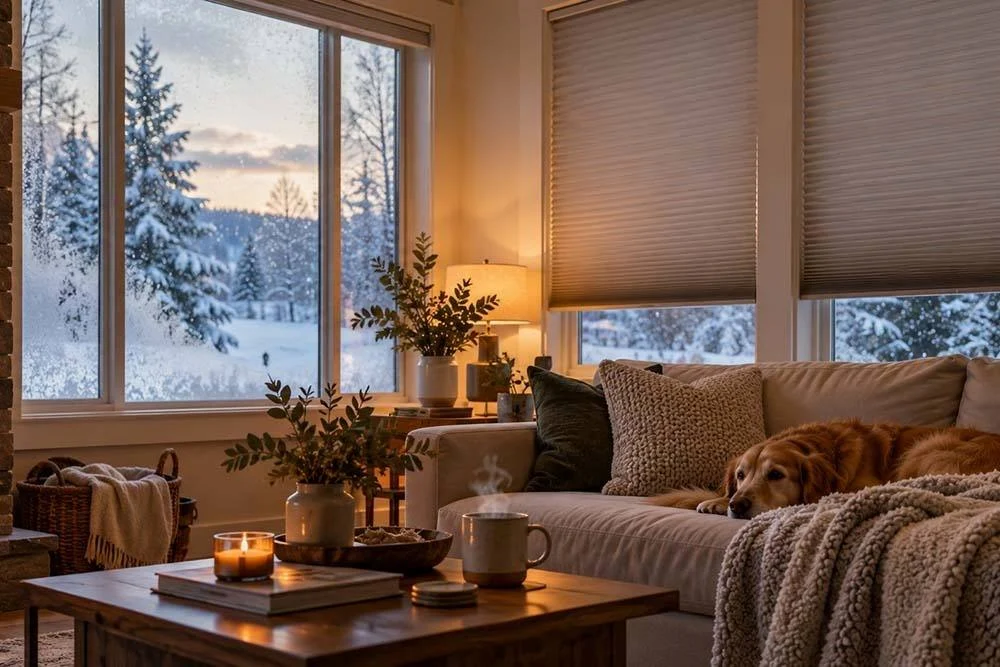
For a Calgary winter, the best window coverings are usually ones that do more than block the view. It should fit closely to the window, reduce the cold feeling near the glass, control drafts and radiant chill, and still give you the privacy and daylight you want. For most homes, well-fitted honeycomb or cellular shades are the strongest starting point because their cellular construction traps air at the window. Blackout roller shades, lined Roman shades, and layered drapery can also be useful when the room has different priorities.
The important point is that no blind can repair a leaking window or replace proper glazing, weatherstripping, and air sealing. Window coverings are the interior layer of a larger comfort strategy. In a cold climate, fit, fabric, mounting style, and how consistently the covering is used can matter as much as the product name.
Why Calgary Winters Make Window Coverings Matter
Calgary homes can experience long heating seasons, sharp temperature swings, and cold glass surfaces that make a room feel uncomfortable even when the thermostat is set correctly. Natural Resources Canada explains that windows, doors, and skylights can represent a significant share of overall home heat loss, and it specifically notes that curtains and blinds can help reduce radiant heat loss during the heating season. That is why window coverings should be chosen as part of the room’s thermal comfort plan, not only as decoration.
A good winter window covering helps in three practical ways: it adds a still layer of air next to the glass, reduces direct radiation between your warm body and a cold window surface, and limits the movement of room air against the cold pane. The closer the shade fits to the opening, the more useful that interior layer can be.
1. Honeycomb or Cellular Shades: Best All-Around Winter Choice
Honeycomb shades are designed with hollow cells that trap air inside the fabric structure. This creates a buffer between the room and the glass. For homeowners whose main problem is a cold room, a chilly seating area beside a window, or a bedroom that loses comfort overnight, cellular shades are often the first option worth comparing.
- Choose a close custom fit. Large side gaps allow air to move around the shade and reduce the benefit.
- Consider double-cell construction when insulation is a high priority, and the window size supports it.
- Use blackout cellular fabric in bedrooms when you also want maximum light control.
- Use light-filtering cellular fabric in living spaces where daylight matters.
- Top-down/bottom-up operation can preserve privacy while still admitting winter daylight from above.
Explore Winmax Honeycomb Blinds for cellular constructions, light-filtering and blackout options, and custom fitting.
2. Blackout Roller Shades: Good for Bedrooms and Simple Interiors
Roller shades use a single sheet of fabric, so they do not create the same cellular air pockets as honeycomb shades. However, a dense blackout fabric that sits close to the window can still improve perceived comfort by reducing radiant chill, blocking drafts from moving directly into the room, and controlling light. They are especially practical for bedrooms, media rooms, and spaces where a clean, minimal look is important.
For winter performance, the fabric is only part of the equation. A custom inside mount with minimal side gaps or a well-planned outside mount can provide better coverage than a ready-made shade that leaves exposed glass around the edges.
See Winmax Roller Blinds to compare blackout, light-filtering, and solar fabrics.
3. Lined Roman Shades: Strong Style With Added Fabric Mass
Roman shades can be a good fit when you want a softer, more furnished look. Their folds and optional lining add fabric mass at the window, and a properly sized shade can reduce the cold feeling coming from the glass. A blackout or thermal lining is generally more suitable for winter comfort than a thin decorative fabric alone.
Roman shades are particularly useful in dining rooms, bedrooms, and formal living spaces where appearance is as important as energy performance. The trade-off is that the folded fabric stack can be larger than a roller or cellular shade, and the product needs to be measured carefully so it does not interfere with handles or trim.
4. Layered Drapery Over a Shade: Best for Very Cold or Drafty Rooms
When a room has a large window, patio door, or persistent cold-zone problem, layering can make more sense than asking one product to do everything. A cellular or blackout shade handles the glass area, while a lined curtain adds another interior layer. The combination can also improve nighttime privacy and create a softer appearance.
The caution is condensation. Natural Resources Canada notes that closed drapes and blinds can reduce air circulation at the glass, which may increase condensation risk in some homes. If you regularly see water or frost on the interior pane, the humidity level, ventilation, and window condition should be addressed rather than simply adding more fabric.
How the Main Winter Options Compare
| Window covering | Winter comfort | Light control | Best for | Main trade-off |
| Honeycomb / cellular | High | Light-filtering to blackout | Cold rooms, bedrooms, living rooms | Higher cost than basic rollers |
| Blackout roller | Moderate | Very high | Bedrooms, media rooms, modern spaces | Less insulating structure |
| Lined Roman | Moderate | High | Bedrooms, dining, decorative spaces | Larger fabric stack |
| Shade + lined drapery | High when well fitted | Very high | Large or especially cold windows | More material; watch condensation |
Custom Fit Matters More Than Many Homeowners Expect
Winter performance can be weakened by avoidable gaps. A shade that is too narrow may look fine from across the room but can leave exposed glass and allow air movement along the sides. A custom measurement also helps determine whether an inside mount is deep enough, whether an outside mount would give better coverage, and whether trim, handles, or window cranks will interfere with operation.
This is where an in-home consultation is useful. Samples can be viewed in the room’s actual daylight, the installer can inspect the window depth and surrounding trim, and the product can be selected around both comfort and design instead of choosing from a standard retail size.
A Simple Room-by-Room Winter Guide
- Bedrooms: blackout cellular shades or blackout rollers; prioritize coverage and nighttime privacy.
- Living rooms: light-filtering honeycomb shades when you want insulation without losing daytime light.
- South- or west-facing rooms: use a product that can manage both winter comfort and strong solar gain on sunny days.
- Street-facing rooms: top-down/bottom-up cellular shades can balance privacy and daylight.
- Large windows: consider wider custom systems, multiple shades, or a layered shade-and-drapery solution.
- Hard-to-reach windows: motorization can make it easier to close the covering consistently at night.
What Blinds Cannot Fix?
If you feel a strong draft around the frame, see deteriorated caulking, or have frequent frost and water accumulation, the root issue may be air leakage, glazing performance, or indoor humidity. A window covering may make the room feel better, but it should not be used to hide a building-envelope problem. Natural Resources Canada recommends addressing air sealing, weatherstripping and window performance as part of a complete efficiency strategy.
For more detail on how cellular shades behave in Calgary cold weather, read Winmax’s related article on Honeycomb Blinds for Calgary Winters.
Frequently Asked Questions
Q1. What blinds are best for cold weather?
A: Well-fitted honeycomb or cellular shades are among the strongest choices because the cells trap air at the window. Blackout rollers and lined Roman shades can also improve comfort when fit and coverage are good.
Q2. Do blackout blinds keep a room warmer?
A: They can help reduce the cold feeling from the glass and limit air movement near the window, especially when the fabric is dense and the shade fits closely. They are not a substitute for insulated windows or air sealing.
Q3. Should blinds stay closed all day in winter?
A: Not always. On sunny windows, opening shades during the day can allow useful solar heat and daylight into the room. Closing them after sunset can help reduce nighttime heat loss and radiant chill.
Q4. Can blinds cause condensation?
A: Any covering that keeps room air away from cold glass can sometimes increase condensation at the pane. Maintain healthy indoor humidity, ventilation, and air circulation, and address recurring moisture rather than ignoring it.
Q5. Are custom blinds better than ready-made blinds for winter?
A: Custom blinds can be measured to reduce side gaps, match the mounting depth, and cover the glass more accurately. That can improve comfort as well as privacy and appearance.
Q6. Do motorized blinds help with energy efficiency?
A: Motorization does not change the fabric itself, but schedules can make it easier to close shades consistently at night and open them when winter sun is useful.
|
Choose winter window coverings around the way your rooms actually feel. |