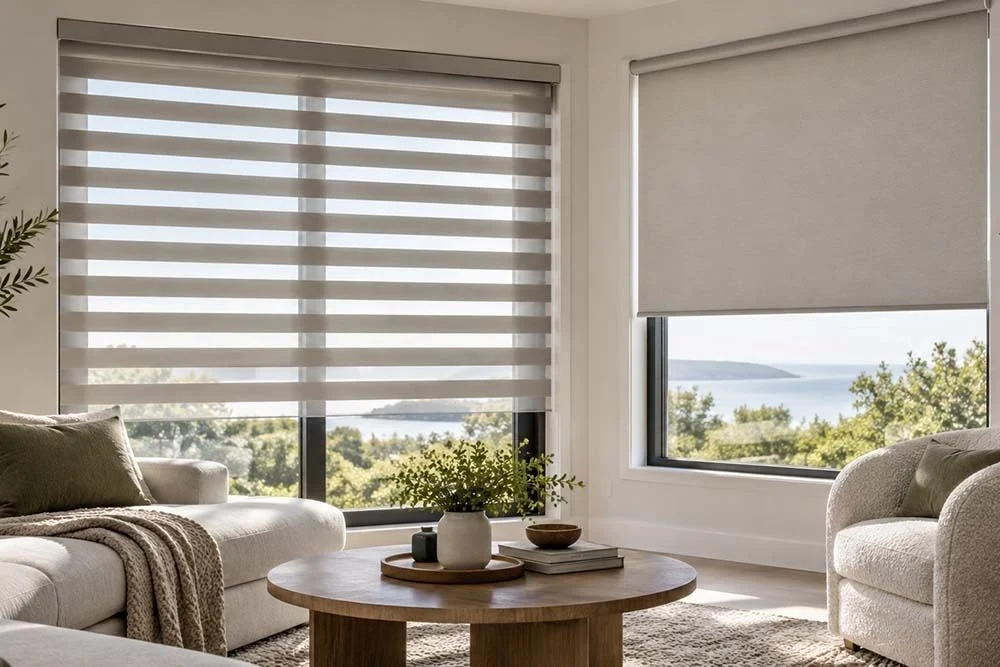
Zebra blinds and roller blinds are often placed in the same shortlist because both have a clean, modern profile. Their day-to-day behaviour, however, is quite different. The simplest distinction is this: zebra blinds are built around adjustment, while roller blinds are built around simplicity.
If you regularly change the relationship between daylight and privacy, zebra blinds deserve a closer look. If you prefer one smooth fabric panel and want the performance to come mainly from the fabric you select, roller blinds are usually easier to understand and operate. The better option is the one that matches how the room is actually used.
How Zebra Blinds Work
A zebra blind uses two layers of fabric with alternating transparent and opaque horizontal sections. As the layers move, the bands can overlap in different positions. That creates a range between more open, filtered light and more closed coverage without requiring the entire blind to be raised.
That layered movement is the defining feature. It is useful in spaces where conditions change through the day, such as a living room that needs daylight in the morning, reduced glare in the afternoon and more privacy in the evening.
How Roller Blinds Work
A roller blind is intentionally more straightforward. One continuous sheet of fabric moves up or down around a tube. Instead of creating privacy through band alignment, the result depends primarily on the fabric chosen: light-filtering, room-darkening, blackout or another performance material.
That simplicity can be an advantage in minimalist interiors and in rooms where you do not need several intermediate settings. You choose the fabric performance first, then operate the blind as one clean panel.
Zebra vs Roller Blinds at a Glance
| Decision Factor | Zebra Blinds | Roller Blinds |
| Daylight adjustment | Very flexible; bands can be shifted without fully raising the blind. | More dependent on the chosen fabric and how far the blind is raised. |
| Visual style | More decorative and patterned because the horizontal bands remain visible. | Quiet, flat and minimal; easy to blend into the room. |
| Night privacy | Good when opaque bands are fully aligned. | Straightforward when an opaque fabric is fully lowered. |
| Room darkening | Possible, but not usually the main reason people choose zebra blinds. | Strong option when paired with room-darkening or blackout fabric. |
| Frequent adjustment | Well suited to rooms where conditions change several times a day. | Excellent when you prefer a simple open/closed routine. |
| Design emphasis | Blind becomes a visible design element. | Blind can recede into the background. |
Which Is Better for a Living Room?
Living rooms often favour zebra blinds because they rarely have only one lighting requirement. You may want an open, bright feeling while entertaining, less glare during television viewing and better privacy after sunset. The band system lets you make those changes without completely exposing or covering the glass.
Roller blinds can still be an excellent living-room choice when you prefer a quieter look or when a single light-filtering fabric already provides the level of control you want. The room design may ultimately be the deciding factor.
Which Is Better for a Bedroom?
For a bedroom, roller blinds usually have the clearer functional advantage when the objective is strong room darkening. A continuous blackout or room-darkening fabric is simple to understand: lower the blind when you want coverage and raise it when you want the window open.
Zebra blinds can provide substantial privacy when their opaque bands are aligned, but their strength is flexible light management rather than the most direct route to a darker sleeping environment.
Which Is Better for a Home Office?
The answer depends on the source of glare. If sunlight shifts across your desk during the day, zebra blinds can be convenient because small adjustments change the amount of exposed sheer fabric. If your office simply needs consistent filtered light, a roller blind with an appropriate fabric can be calmer and visually cleaner.
Do not judge office glare while standing at the window. Sit in the actual working position and look at the screen. The useful blind is the one that solves the problem from where you work.
Which Gives Better Privacy?
For daytime privacy with some retained brightness, zebra blinds provide useful flexibility. You can interrupt direct sightlines while still allowing filtered light through portions of the window. At night, however, the opaque bands need to be fully aligned if privacy is important.
Roller blinds are less nuanced but very predictable. When an opaque fabric is lowered, there is one continuous layer between the room and the window. That predictability is often reassuring in bedrooms and street-facing spaces.
What About Large Windows and Motorization?
Both systems can work on many large windows, but width, fabric weight, mounting conditions and operator limits need to be considered. A very wide opening may be better divided into two or more blinds so the finished installation operates smoothly and looks balanced.
Motorization can make sense for either style when the window is high, wide or adjusted frequently. It is a convenience decision rather than a reason to choose zebra over roller by itself.
A Better Way to Decide
Instead of asking which blind is “better,” choose the statement that sounds more like your household. If you often fine-tune light and privacy during the day, start with zebra. If you want a restrained appearance and a clear open-or-covered routine, start with roller. If the home contains both situations, using both products in different rooms is entirely reasonable.
You can compare the Winmax Zebra Blinds and Roller Blinds pages before reviewing samples in your own space.
Original Visual Proof to Add
| Use real Winmax project imagery rather than generic stock photos.
· Side-by-side Winmax installations photographed in rooms with similar window sizes. · A zebra blind shown in open-band, half-adjusted and privacy positions. · A roller blind shown with light-filtering and room-darkening fabric examples. |
Frequently Asked Questions
Q1. Are zebra blinds better than roller blinds?
A: They are better for some priorities, not all. Zebra blinds excel at adjustable light and daytime privacy. Roller blinds excel at simplicity, minimal styling and straightforward room-darkening options.
Q2. Which option is better for bedrooms?
A: A roller blind with room-darkening or blackout fabric is often the more direct bedroom solution when reducing light is the main goal.
Q3. Do zebra blinds provide privacy at night?
A: Yes, when the opaque bands are correctly aligned. Sheer sections should not be left open if strong nighttime privacy is required.
Q4. Which blind looks more modern?
A: Both can look modern. Zebra blinds create a stronger graphic pattern, while roller blinds have a quieter, more architectural appearance.
Q5. Can zebra and roller blinds be motorized?
A: Depending on the selected system and dimensions, motorized configurations may be available for both types.
Q6. Can I use zebra blinds in living areas and roller blinds in bedrooms?
A: Yes. Using different products by room is often the most practical approach because each space has different lighting and privacy needs.
| Compare real fabric samples in the room where the blinds will live. |