
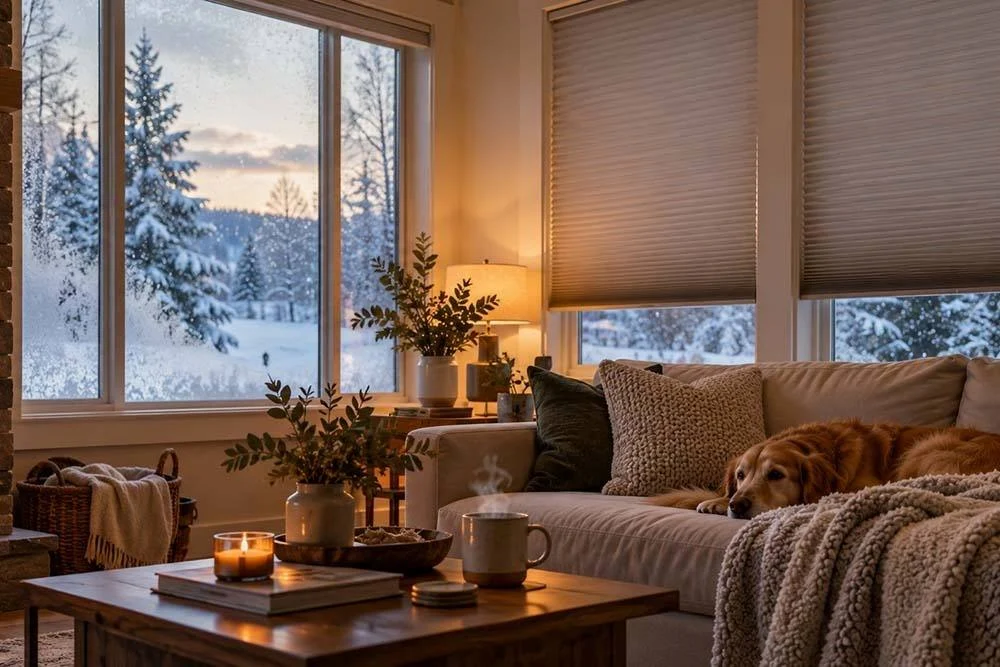
Windows can be one of the largest weak points in a home’s thermal envelope. Natural Resources Canada states that windows, doors, and skylights can account for up to 35 percent of total house heat loss. That does not mean every home loses exactly that amount through windows, but it shows why cold glass, air leakage and poorly performing frames can have a major effect on comfort and heating demand.
Blinds can help, particularly well-fitted cellular shades and dense window coverings. They add an interior layer that reduces radiant heat loss and slows air movement at the glass. They cannot fix a failed window seal or major frame leak, but they can make a noticeable difference in how the room feels and how quickly heat moves through the covered window area.
Where the Heat Actually Goes
Heat loss through a window is not one single process. Several mechanisms happen at the same time. Understanding them makes it easier to see what a blind can and cannot change.
- Conduction: heat moves through the glass, spacer, sash, and frame materials toward the colder outdoors.
- Radiation: warm interior surfaces and people radiate heat toward the colder glass surface, which is why sitting beside a window can feel chilly even without a strong draft.
- Convection: room air cools when it contacts the glass, becomes denser and drops, creating a cold downdraft near the window.
- Air leakage: outdoor air can enter through gaps in seals, frames, or trim, while heated indoor air escapes.
A window covering mainly affects the room-side radiation and convection, and sometimes the amount of air movement immediately over the glass. It does not change the frame construction or repair air leaks around the window.
Why the Room Can Feel Colder Than the Thermostat Says
Thermostats measure air temperature, but comfort also depends on the temperature of surrounding surfaces. If the window glass is very cold, your body exchanges more radiant heat with that surface. That is why a chair near an exterior window can feel uncomfortable even when the room is technically at the same air temperature as a warmer interior room.
A closed shade places another surface between you and the glass. If that shade surface stays warmer than the glass, radiant comfort can improve. Cellular shades go one step further by adding trapped air pockets, which reduce heat transfer through the shade itself.
Can Blinds Really Reduce Winter Heat Loss?
Yes, but the result varies widely. Natural Resources Canada specifically notes that curtains and blinds can help reduce radiant heat loss during the heating season. The U.S. Department of Energy has also documented measurable energy-performance benefits from well-fitted cellular shades. Those findings support using window attachments as one part of a broader efficiency plan.
The phrase “well-fitted” is important. A shade that leaves large side gaps permits air to circulate behind it. A product that closely covers the opening creates a more effective interior buffer. For energy-focused rooms, custom measurement can therefore be more important than choosing the thickest-looking fabric on a shelf.
Which Blinds Help Most?
Honeycomb / Cellular Shades
These are generally the strongest blind-style option for insulation because the cellular construction traps air. Single-cell shades provide one row of pockets; double-cell products add another layer. Blackout cellular fabric can combine thermal buffering with strong light control for bedrooms.
Learn more about Winmax Honeycomb Blinds and Cellular Shades.
Blackout Roller Shades
A dense roller shade can reduce the cold feeling from the glass and limit direct air movement at the pane. It does not have cellular pockets, so its insulating structure is simpler, but it remains a practical choice for bedrooms and modern interiors where blackout and clean lines are important.
Compare Winmax Roller Blinds for blackout and light-control fabrics.
Lined Fabric Shades and Drapery
Additional fabric layers can reduce radiant chill and improve nighttime privacy. For especially large or cold windows, a shade plus lined drapery can provide a layered solution. However, more tightly closed fabric can also reduce airflow over the glass, so condensation needs to be watched.
What About Better Windows?
If the existing window has failed seals, strong drafts, damaged frames, or very poor glazing, the biggest improvement may come from fixing the window itself. Natural Resources Canada recommends measures such as weatherstripping, air sealing, adding storm windows in suitable situations, or replacing the unit with a more efficient window when justified.
Efficient glazing features such as low-emissivity coatings, insulating gas fills, and additional panes reduce heat transfer at the source. A blind then becomes the interior control layer for privacy, light, and additional comfort. The two strategies are complementary rather than interchangeable.
A Practical Winter Window Checklist
- Stand near the closed window on a cold day. Determine whether the problem feels like a draft, cold glass, or both.
- Check locks, weatherstripping, and visible gaps around the sash and trim.
- Look for condensation or frost, which can signal a combination of cold surfaces, humidity, and ventilation conditions.
- Choose a window covering that fits the room’s main need: insulation, blackout, privacy, glare control, or design.
- Measure accurately so the shade covers as much of the opening as practical without interfering with operation.
- Use the covering strategically: open it for useful winter sun and close it before evening heat loss increases.
How Much Can You Save?
A single universal savings number would be misleading. The answer depends on window area, glazing type, air leakage, shade construction, climate exposure, heating system, indoor setpoint, and how many hours the covering stays closed. A well-fitted cellular shade on a large older window has a different impact from the same shade on a small modern triple-glazed unit.
For homeowners, the more reliable way to evaluate a blind is to focus on comfort first: does the room stay more even, does the cold downdraft reduce, and can you sit or sleep closer to the window without feeling chilled? Energy savings can follow, but the actual bill impact is home-specific.
One Important Caution: Condensation
Closing a shade reduces air circulation across the glass. Natural Resources Canada notes that deep sills, closed drapes and blinds, and nearby furniture can allow cool air to pool near a window and contribute to condensation. If you see water building up behind the blind, do not simply leave it there all winter. Reduce indoor humidity when needed, use ventilation, and allow some airflow so the window can dry.
Frequently Asked Questions
Q1. What percentage of heat is lost through windows?
A: Natural Resources Canada says windows, doors and skylights can account for up to 35 percent of total house heat loss. The actual share in an individual home varies with the building, window area, and window performance.
Q2. Can blinds replace window insulation?
A: No. Blinds are an interior attachment. They can reduce heat transfer and improve comfort, but they do not replace proper glazing, insulated frames, weatherstripping or air sealing.
Q3. What blinds are best for winter insulation?
A: Well-fitted honeycomb or cellular shades are usually the strongest blind-style option because their cells trap air. Blackout roller shades and lined fabric treatments can also help.
Q4. Should I close blinds at night in winter?
A: Generally, closing an insulating window covering after sunset can reduce radiant chill and heat loss at the window. On sunny winter days, opening it can allow useful daylight and solar warmth.
Q5. Why is there water behind my blinds in winter?
A: The glass may be cold enough for indoor moisture to condense, and a closed blind can reduce airflow across the pane. Manage humidity, ventilation, and any underlying window issues.
Q6. Are new windows always better than new blinds?
A: They solve different problems. New windows can improve the building envelope; blinds add light, privacy and an extra interior thermal layer. If the existing window is sound, upgrading the covering may be a practical first step.
|
Find out whether the problem at your window is fit, fabric, air leakage – or all three. |